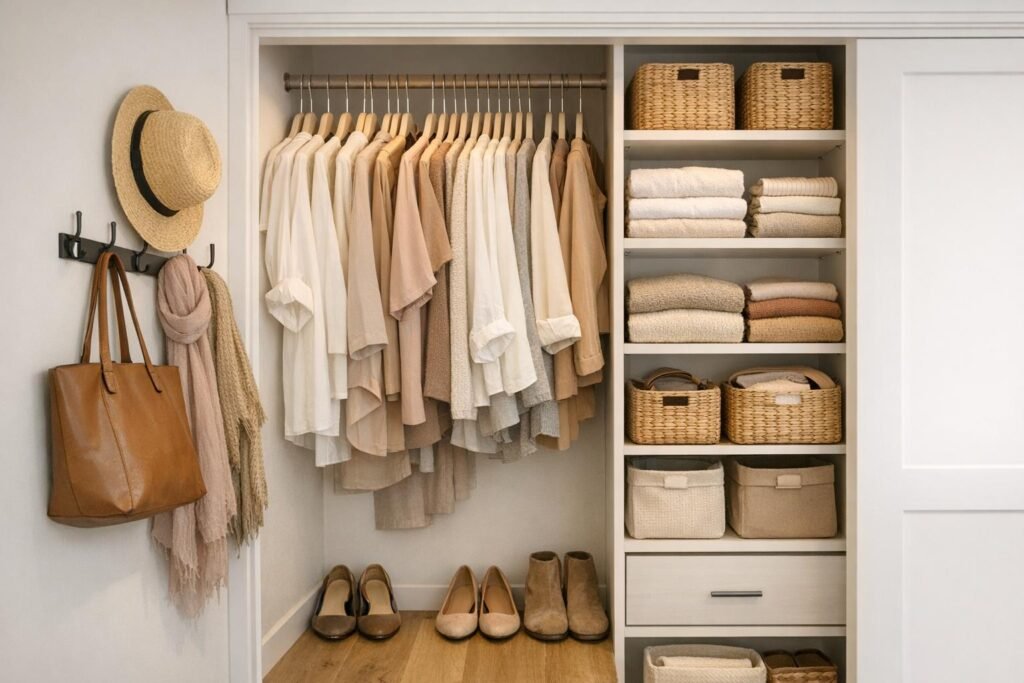
Feeling like your closet is too small? You’re not alone. Many struggle with cramped closet spaces, but the good news is, you don’t need a costly renovation to fix it. By focusing on smarter organization and decluttering, you can create a functional and stress-free closet. Here’s how:
- Declutter first: Use the 90-day rule to decide what stays or goes. Sort into “Keep,” “Donate/Sell,” and “Trash” piles.
- Upgrade hangers: Slim velvet hangers save space and prevent clothes from slipping.
- Use vertical space: Try hanging fabric shelves, over-the-door organizers, and wall hooks.
- Rotate seasonally: Store off-season clothes in vacuum bags or bins to free up space.
- Organize small items: Drawer dividers and labeled bins keep accessories tidy.
- Maximize floor and top shelves: Shoe racks and lidded boxes help utilize every inch.
These simple adjustments can transform even the tiniest closet into a practical, organized space. Let’s dive into the details.
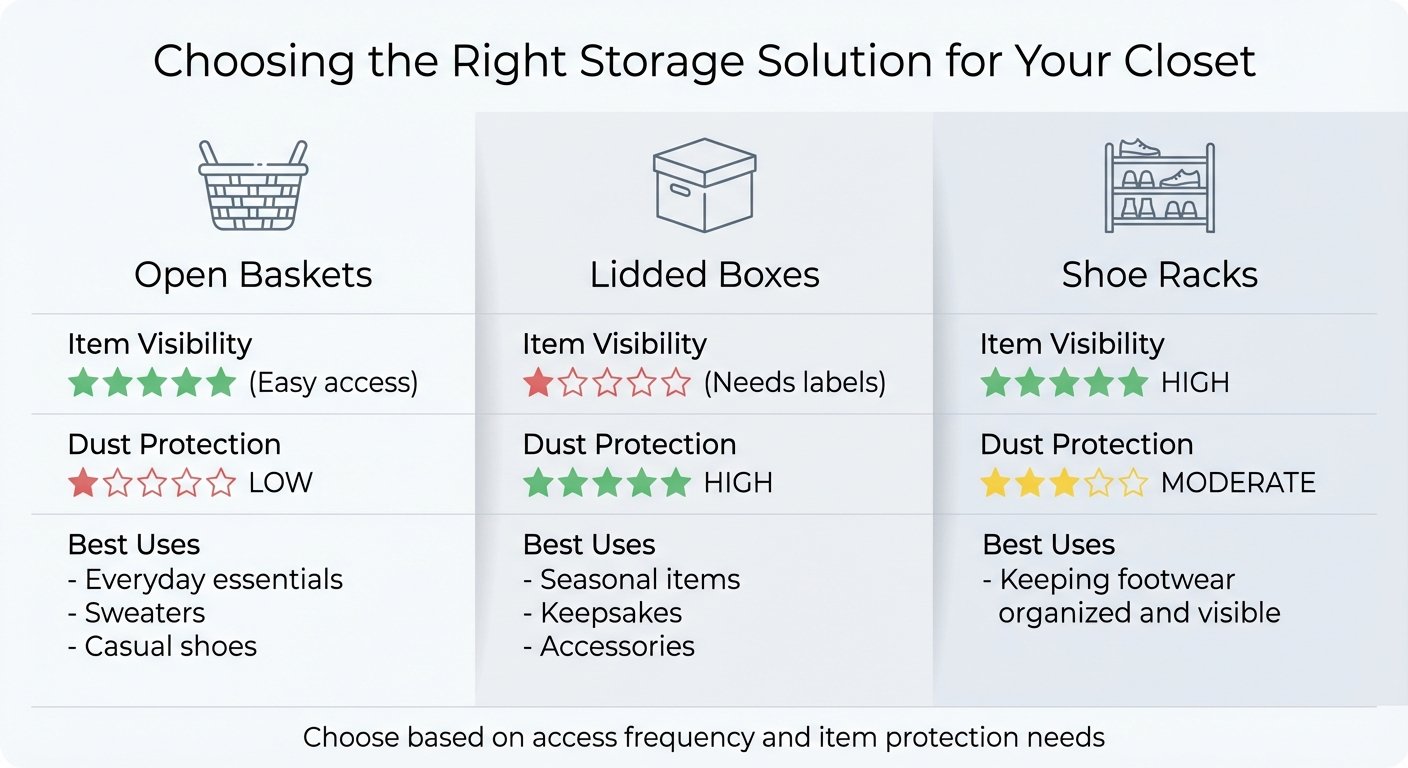
Storage Solutions Comparison: Open Baskets vs Lidded Boxes vs Shoe Racks
Closet Organization that ACTUALLY Works (Small Closet Organizing without losing my mind!)
sbb-itb-9502fca
1. Declutter and Edit Your Wardrobe
Before diving into organizing, the first step is to make space by getting rid of what doesn’t belong. Jamie Hord, Cofounder of Horderly Professional Organizing, emphasizes:
Editing your belongings before organizing is crucial.
A quarter of women feel their closets are disorganized, and nearly half admit they struggle to find specific items at least once a month. Tackling this starts with a closet cleanse.
Start With a Closet Clean-Out
Begin by working systematically – move from left to right along your closet rod to stay organized. Sort each item into three categories: Keep, Donate/Sell, and Trash/Recycle. Use the 90-Day Rule: if you haven’t worn something in the past 90 days and don’t plan to wear it in the next 90 (excluding seasonal items), it’s time to let it go.
Remove anything stained, torn, or with broken zippers. Relocate items that don’t belong in your closet. Lisa Zaslow, Founder of Gotham Organizers, advises:
If you barely have space for essentials like sweaters, don’t use this closet to store boxes of mementos, sports equipment, or holiday items.
Also, get rid of dry-cleaning plastic to protect your fabrics and free up space.
Once your closet is pared down, you can test its functionality with simple hanger strategies.
Use a Hanger Test to Limit Your Closet
Here’s a clever way to figure out what you actually wear: turn all your hangers backward at the start of the year. After wearing an item, return it to the closet with the hanger facing the right way. In six months, any hangers still turned backward will reveal clothes you never touched.
Stick to 40–50 hangers to ensure you’re keeping only your favorites. Lisa Zaslow suggests:
If you’ve maximized your space and are at capacity, you should probably let something go whenever you bring something new in.
Focus on Key Wardrobe Pieces
Hold on to clothes that can create at least five different outfits. Prioritize versatile staples like well-fitting jeans, classic blazers, and tops that pair with multiple items. These essentials give you more styling options without taking up too much space.
To keep clutter from creeping back, place a permanent donation bin in your closet or car trunk. The moment you realize something no longer serves you, drop it in. This simple habit keeps your wardrobe in check after the initial clean-out.
2. Maximize Hanging Space with Smart Hangers
After decluttering, it’s time to rethink your hangers. The right hangers can nearly double your hanging space – all without adding a single new rod. Start by ditching bulky plastic and wooden hangers in favor of more efficient options.
Slim Velvet Hangers: A Space-Saving Staple
Slim velvet hangers are a game-changer for small closets. Their sleek design takes up far less space than traditional hangers, allowing you to fit more clothes on the same rod. Plus, the velvet coating keeps even delicate silk tops or wide-neck blouses securely in place, so nothing ends up on the floor.
Shaniece Jones, Founder and Chief Organizing Officer at One Woman Army Management, highlights their benefits:
Velvet hangers are the number one choice. Thanks to their slimmer profile, the velvet kind saves a lot of space, and the fabric helps keep clothes where they belong.
You can snag a 50-pack of heavy-duty velvet hangers for around $29.99. Using a uniform set of hangers throughout your closet not only maximizes space but also reduces visual clutter, making the area look more polished and organized. Save your sturdy wooden hangers for heavier items like winter coats or structured blazers that need extra support.
Tiered and Specialty Hangers for Extra Efficiency
Cascading hangers are a brilliant way to multiply your closet’s capacity, allowing you to hang several shirts or blouses vertically from a single rod point. This frees up horizontal space for other garments.
For pants and skirts, tiered clip hangers are your best bet. Clip jeans at the waistband to keep them hanging flat, avoiding the need for bulky shelf storage. Want to get creative? Attach shower curtain rings to a hanger’s bar to neatly organize scarves by color. Carabiner clips can work just as well for belts or long necklaces.
Once you’ve optimized hanging space, organizing your garments strategically will make your daily routine even easier.
Organize by Category and Purpose
Group your clothes by category: workwear, casual items, and dressy outfits should each have their own section. This setup makes finding what you need a breeze. You can also use labeled rod dividers (a 30-piece set costs about $9.75) to clearly define each category.
Finally, align all hanger hooks in the same direction for a clean, streamlined appearance. If you find it difficult to slide hangers and browse your clothes, it’s a sign your closet is still overcrowded and may need another round of decluttering.
3. Optimize Vertical Space
Once you’ve made the most of your hanging space, it’s time to think vertically. Many closets have untapped potential in their walls, doors, and higher areas. Using these spaces effectively can help turn your cluttered closet into a well-organized and stylish haven.
Add Hanging Fabric Shelves
Hanging fabric shelves are a simple yet effective way to create extra storage. These shelves attach directly to your rod, providing multiple tiers for items like folded sweaters, handbags, and accessories. Folding sweaters is especially important to help them keep their shape. Tina Priestly, Founder of Ready, Set, Refresh!, offers this handy tip:
Things you use most often can be in the eye line; less regular items can go in top or bottom spaces that are more difficult to access.
Seasonal items can go in the higher compartments, while everyday favorites should stay at eye level for easy access. Affordable options are widely available, starting at around $8.00 at Target, while IKEA‘s JONAXEL storage combinations are priced from about $29.99.
Use Over-the-Door Organizers
Don’t overlook your closet door – it’s valuable storage space. Over-the-door organizers are perfect for storing shoes, bags, or other bulky items without taking up floor space. Models with clear PVC pockets make it easy to see your items at a glance.
For heavier items like boots or larger handbags, reinforced organizers with hooks are a better choice. The Ofiray-home 5-tier organizer, for example, supports up to 80 lbs and includes 10 compartments plus 10 side pockets. It’s priced between $20.00 and $35.00. Just be sure to measure your door (usually 1.4"–1.73") to ensure it closes properly when the organizer is loaded. These door solutions work well alongside wall-mounted storage, which we’ll touch on next.
Incorporate Hooks and Peg Rails
Wall-mounted hooks are a versatile way to use those awkward corners or small wall sections in your closet. Carol Appelbaum, Founder of Luxury Pro Organizer, suggests:
Adding hooks could be an efficient solution for storing items like hats, bags, scarves, and belts.
If drilling isn’t an option, no-drill suction hooks are a great alternative. These can be attached to the back of wardrobe doors and hold items like belts or bags securely.
Another clever idea is to install a towel bar inside your closet door. You can use it to hang multi-loop scarf hangers (around $5.00 for an 8-hoop version) or belt hangers (approximately $6.00 for a 4-belt style). This keeps accessories neatly displayed and easy to grab, saving you time during those busy mornings.
4. Rotate by Season and Store Smart
If your closet feels like it’s bursting at the seams, chances are you’re holding onto clothes you won’t wear for months. A seasonal rotation system can help. By keeping only what you need for the current season within arm’s reach and storing the rest, you’ll instantly free up space and make your daily routine a whole lot easier. This simple strategy not only declutters your closet but also keeps things organized year-round.
Adopt a Seasonal Rotation System
Switch out your wardrobe twice a year to keep it seasonally appropriate. Before storing items, take a moment to fix any minor issues – like sewing on loose buttons or removing pilling – so everything is ready to wear when the season rolls around. Professional organizer Mary Cornetta sums it up perfectly:
My future self will thank you.
Use this wardrobe swap as a chance to reassess what you actually wear. If that sweater stayed untouched all winter or those linen pants never left the drawer last summer, it might be time to donate them. For occasional-use pieces, like a lightweight cardigan, consider storing them under the bed. For larger storage needs, make use of less-trafficked spaces like guest room closets or bins on high shelves. Just make sure stored items are a few feet off the ground to protect them from water or pests.
Use Vacuum Bags and Storage Bins
Vacuum-seal bags are a lifesaver for bulky items like winter coats and heavy sweaters. These bags can shrink storage volume by up to 75%, making them ideal for tight spaces. Reserve them for items you won’t need until next season.
For easier access, use clear, lidded plastic bins to store other off-season clothing. The lids will keep your items dust-free while allowing you to stack the bins safely. If your bedroom has carpet, under-bed bins with wheels make a great option – they slide out effortlessly. And if you’re short on storage containers, empty suitcases can double as temporary storage for out-of-season clothes. Once everything is packed, the next step is to organize and protect your stored items.
Protect and Label Stored Items
Delicate fabrics like silk and cashmere need extra care – opt for breathable storage bags to keep them in good condition. When it’s time to bring these items back into your closet, give them a quick wash to freshen them up.
Labeling is your secret weapon for staying organized. Mark each bin by category, like “Winter Sweaters” or “Summer Dresses,” and label opposite sides for different seasons. Then, as the weather shifts, simply rotate the bins. This small effort can save you loads of time and keep your system running smoothly throughout the year.
5. Organize Small Items with Dividers and Bins
Once you’ve made the most of your hanging and vertical space, it’s time to focus on the smaller items that can easily create clutter. Socks, jewelry, scarves – these little things can quickly turn drawers and shelves into a chaotic mess. The solution? Dividers and bins. These tools help you create specific zones for each category, keeping everything neat, visible, and easy to grab. By combining these with your existing vertical and seasonal organization, you’ll have a system that keeps even the smallest accessories in check.
Use Drawer Dividers for Intimates
Spring-loaded dividers are a game-changer for keeping your intimates organized. They ensure everything stays separated, even when you’re in a rush. Folding items vertically can make it easier to see and access every piece.
Organizer Shantae Duckworth shares a practical tip for socks:
Use drawer dividers and separate your socks by solid colors, patterns, dress, or athletic socks.
For jewelry or watches, velvet-lined organizers are a smart choice to prevent tangling or scratching. Clear plastic bins work well for visibility, while a DIY option like cutting PVC pipes to drawer height can create custom compartments for ties, belts, or scarves.
Before purchasing any dividers, be sure to measure your drawer dimensions carefully. Lisa Zaslow, founder of Gotham Organizers, emphasizes:
A quarter of an inch can make the difference between a great solution and a waste of money.
Store Accessories in Clear Bins
Clear bins are perfect for keeping accessories organized and dust-free. Look for options with lids and front labels to make finding items a breeze. For high shelves, acrylic dividers can help create smaller, manageable zones. Monica Leed from Simply Spaced explains:
The dividers help you create small zones within the closet.
Labeling bins above eye level can save you time when searching for specific items. Square or rectangular bins are particularly efficient since they eliminate wasted corner space and stack neatly. For a budget-friendly option, IKEA’s SKUBB Box set of six costs just $8.99 and is great for corralling accessories.
Designate Baskets for Specific Categories
To take your organization to the next level, assign baskets to specific categories like sleepwear, swimwear, or activewear. This frees up hanging space while keeping everything easy to find. Fabric bins are ideal for soft items like pajamas or winter accessories – they’re breathable and gentle on delicate fabrics.
For a polished look, go with baskets in neutral tones or natural materials like water hyacinth. If you prefer to see the contents at a glance, clear plastic bins are a better option. The SNSLXH stackable closet organizer is a popular choice, boasting 4.5 out of 5 stars from 2,923 Amazon reviews and over 10,000 purchases in December 2025 alone. Stackable designs allow you to maximize vertical shelf space without worrying about stability.
6. Utilize Floor and Top Shelf Space
When it comes to maximizing your closet, every inch counts. From the floor to the often-overlooked top shelf, these spaces can provide much-needed storage if used thoughtfully. The trick is to approach them with purpose, avoiding the temptation to let them turn into clutter zones.
Make the Most of Floor Space with Shoe Racks
The floor of your closet shouldn’t become a dumping ground for stray sneakers or gym bags. Instead, transform it into a functional storage area. Lauren Hill, Divisional Merchandise Director at The Container Store, suggests:
Clear up floor space by installing elevated drawers, wall hooks, and floating shelves.
For shoes, a dedicated rack is a simple yet effective solution. To save space, try alternating the direction of your shoes – place one toe-forward and the other heel-forward. This small adjustment can help you fit more pairs on the rack. For everyday footwear like sneakers or mules, use a large basket on the floor for quick and easy access.
When choosing storage bins for the floor, the shape is crucial. Jimmy Seifert, Closet Buyer at The Container Store, advises:
I would avoid round bins and go with something more square, so you utilize more of your space, creating modularity.
Square or rectangular bins are more space-efficient, as they eliminate wasted corners. To keep your closet looking neat, opt for bins in solid or matching colors, which help reduce visual clutter. Once your floor is organized, you’ll have a clean slate to focus on the top shelf.
Top Shelf Storage with Lidded Boxes
The top shelf is a prime spot for storing items you don’t need every day. Think of it as a place for special occasion shoes, evening bags, or off-season clothing. Lidded boxes are ideal for keeping these items dust-free and your closet looking polished. To stay organized, label each box for easy identification. If you want even more convenience, consider drop-front boxes, which allow you to access items at the bottom without having to unstack everything. For easy access to these higher shelves, keep a foldable step stool nearby.
Choosing the Right Storage Solution
Different storage tools serve different needs, so it’s important to pick the right option based on what you’re storing and how often you need to access it. Here’s a quick comparison:
| Storage Option | Item Visibility | Dust Protection | Best Uses |
|---|---|---|---|
| Open Baskets | High (Easy access) | Low | Everyday essentials, sweaters, or casual shoes |
| Lidded Boxes | Low (Needs labels) | High | Seasonal items, keepsakes, or accessories |
| Shoe Racks | High | Moderate | Keeping footwear organized and visible |
Open baskets are perfect for frequently used items, while lidded boxes are better for things you need to protect but don’t use often. Shoe racks strike a balance, offering visibility and organization for your footwear without taking up too much space.
Conclusion
A small closet doesn’t have to limit your style. By clearing out unnecessary items, using vertical space wisely, choosing efficient hangers, rotating seasonal clothing, organizing accessories, and optimizing floor and shelf areas, you can transform even the tiniest closet into a practical and inviting space. These methods not only save room but also make your daily routine more manageable.
As Meaghan Kessman puts it:
A well-organized closet is easily accessible, clutter-free, neatly categorized by type and color, and visually calming. The layout should feel orderly and make selecting clothes a smooth, stress-free experience.
An organized closet does more than create extra space – it can reduce stress by lowering cortisol levels. It simplifies your day and boosts confidence, ensuring your wardrobe aligns with your lifestyle. Julie Purpura, Owner and Design Director of Avenir, emphasizes:
If you have a small closet, you have to live a small closet lifestyle.
This means being thoughtful about what you keep and parting with items that no longer serve you. Following strategies like the Five Outfit Rule, the 90-Day Rule, and the One-In, One-Out Rule can help maintain order. By adopting these habits, you can turn your small closet into a stress-free, stylish space that works for you.
FAQs
How do I decide which clothes to keep or donate?
Start by emptying your closet completely and sorting everything into three categories: keep, donate, and maybe. If you haven’t worn an item in the past year, it doesn’t fit, or it no longer matches your style, it’s time to let it go. Keep only the clothes that fit well, make you feel great, and are staples in your routine.
For those "maybe" items, try the 90-day test: pack them away in a bag and store them somewhere out of sight. If you don’t find yourself reaching for them over the next three months, it’s probably time to donate them. To streamline the donation process, keep a designated bin in your home or car, and drop it off at a local charity once it’s full.
By focusing on what you truly wear, what complements your lifestyle, and what brings you joy, you’ll end up with a wardrobe that feels tailored to your needs and space.
How can I make the most of vertical space in a small closet?
Maximizing the vertical space in a small closet can completely transform its functionality. Start by installing double-hanging rods: position one rod about 6 feet high for longer items like dresses and coats, and place a second rod approximately 3 feet above the floor for shorter pieces such as shirts and skirts. Above the top rod, add a high shelf to store seasonal items in clear bins – easy to access but neatly out of the way.
Don’t forget to utilize the walls and door for additional storage. Wall-mounted hooks, slim rails, or over-the-door organizers are excellent for keeping scarves, belts, jewelry, or even shoes tidy. On lower shelves, stack clear bins or cubbies, building upward to take advantage of the full height while keeping contents visible and easy to grab.
To keep things even more organized, consider using vertical dividers or tension rods. These can create smaller sections for folded clothes or lightweight items, ensuring everything has its place. By combining these strategies, you can make every inch of your closet work harder while maintaining a clean, organized look.
What’s the best way to rotate seasonal clothing in a small closet?
Keeping a small closet tidy all year can feel like a challenge, but a simple seasonal rotation can make all the difference. Start by pulling out items that don’t belong in the current season – think heavy sweaters in summer or sundresses in winter. Pack these away in clear bins or vacuum-seal bags, and don’t forget to label them with the season and year (like "Winter 2025") so you can easily find them later. Stash these containers on high shelves, under the bed, or in any vertical storage space to keep them out of the way.
For the clothes you’re wearing now, focus on making everything easy to see and grab. Slim, space-saving hangers can maximize space, and arranging items by type or color adds a touch of order. Accessories can stay neat with shelf dividers or hanging organizers, keeping things like scarves, belts, or bags within reach but out of chaos.
Every few months, take a moment to reassess your wardrobe. If you haven’t worn something in a while, consider donating it. This habit helps keep your closet functional, uncluttered, and ready for whatever the season brings.