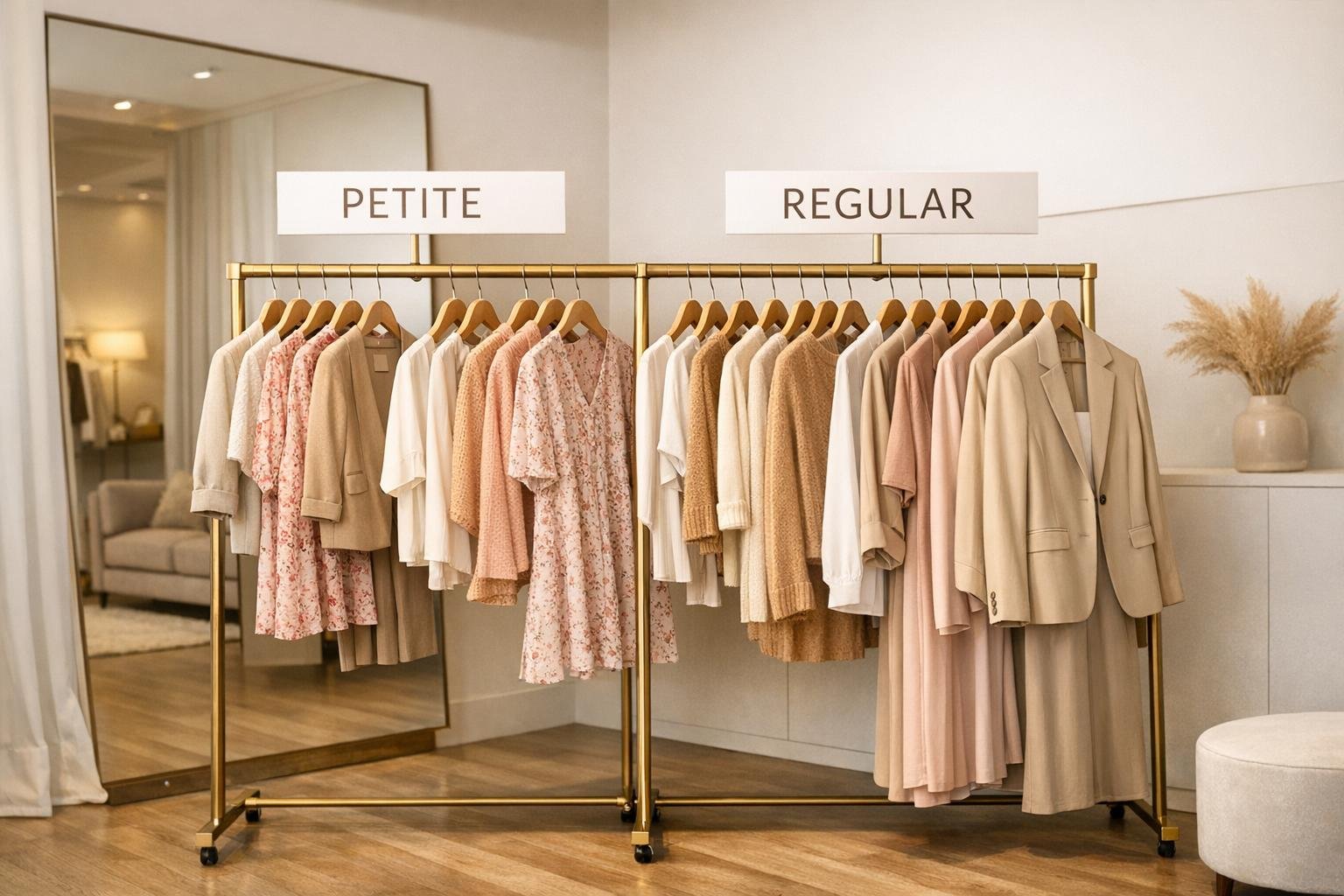
Finding the right clothing size can feel tricky, especially when deciding between petite and regular sizing. Here’s a quick breakdown to help you make the best choice:
- Petite sizing is designed for women under 5’4", with shorter proportions in the torso, sleeves, and legs. Common adjustments include higher knee placement, shorter rises, and narrower shoulders.
- Regular sizing works best for women between 5’4" and 5’8", offering longer lengths and broader fits for average proportions.
If you’re unsure, focus on how clothes fit your body rather than just your height. Petite options might suit you better if sleeves or pant legs are too long, while regular sizes may be ideal for a longer torso or broader frame.
Quick Comparison
| Feature | Petite Sizing (Under 5’4") | Regular Sizing (5’4" to 5’8") |
|---|---|---|
| Height Range | Under 5’4" | 5’4" to 5’8" |
| Inseam | 26"–28" | 29"–31" |
| Torso Length | Shorter | Standard |
| Shoulders | Narrower | Broader |
| Sleeve Length | Shorter | Longer |
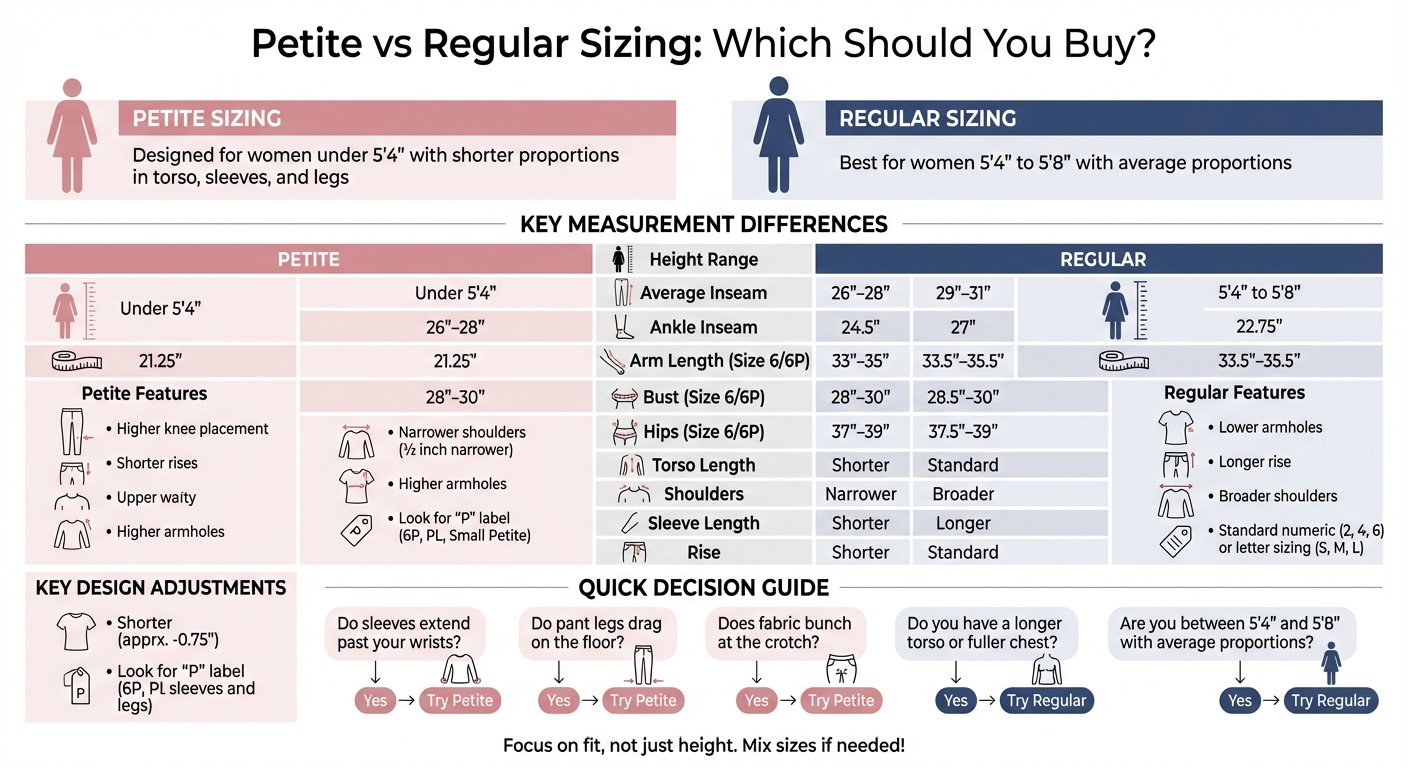
Petite vs Regular Sizing: Complete Measurement Comparison Chart
Petite Size 101: How is it different from regular size?
sbb-itb-9502fca
What Is Petite Sizing?
Petite sizing is designed specifically for women who are 5’4" and under, focusing on height and proportions rather than weight. This category includes a range of sizes, from extra-small to plus-size, sometimes labeled as "petite-plus" or "extra-large petite". If you’ve ever found that size 8 pants fit perfectly at the waist but drag on the floor, the issue likely lies in the garment’s proportions, not the numerical size.
Fashion stylist Aliesha Hatalovsky sheds light on this:
"Usually, under five foot four inches is considered petite, but people with shorter torsos, legs, or frames may also benefit from petite sizing."
Even if you’re close to 5’5", features like a shorter torso or narrower shoulders might mean petite cuts provide a better, more tailored fit than regular sizes.
Unlike standard sizing, which scales garments evenly, petite sizing adjusts vertical proportions for a more precise fit. For example, tops are designed with a shorter neck-to-waist length to prevent them from looking overly long, while inseams typically measure 27 inches or less – about 2 inches shorter than standard lengths. Other adjustments include higher knee placement, raised armholes, and narrower shoulders to better accommodate smaller frames.
When shopping, look for sizes marked with a "P" (like 6P or PL). This indicates the piece has been proportionally adjusted rather than simply resized. If you frequently notice sleeves extending past your wrists, pant pockets sitting too low, or fabric bunching at the crotch, these are signs that petite sizing might be the right choice for you.
Interestingly, petite sizing has been around since the 1940s. Designer Hannah Troy introduced it after realizing that more than half of women needed garments with shorter torso measurements. This tailored approach has remained relevant ever since, offering a better fit for smaller frames.
What Is Regular Sizing?
Regular sizing, often referred to as "missy" or "straight" sizing, is the fashion industry’s standard for women who fall between 5’4" and 5’8" in height. If you’re in this height range and find that most off-the-rack clothing fits well without needing significant adjustments, chances are you’re shopping in the right category.
Unlike petite sizing, which modifies proportions for shorter frames, regular sizing is tailored for an average build. This includes longer torso lengths from neck to waist, broader shoulders, and lower armholes compared to petite designs. Sleeves typically reach the wrist, and inseams are about 2 inches longer than those in petite sizes. Pants in this category feature a longer rise – the distance from the crotch seam to the waistband – which ensures that the fabric sits comfortably on the hips without riding too high. Even small details, like where the knees fall in pants or the placement of pockets, are adjusted to suit a taller frame.
Of course, body proportions can vary widely, even among women of the same height. For example, women with longer legs or a fuller chest often find that regular-sized pants provide the necessary inseam, while regular tops offer a better fit for their upper body. Ultimately, your unique proportions are just as important as your height when determining the best fit.
When shopping, regular sizes are labeled with standard numeric (2, 4, 6) or letter-based (S, M, L) sizing, without the "P" designation used for petite clothing. However, keep in mind that sizing isn’t consistent across all brands. A size that fits perfectly from one retailer might feel slightly longer or shorter from another.
Main Differences Between Petite and Regular Sizing
When it comes to petite and regular sizing, the differences go far beyond just height. These sizing categories involve adjustments across the entire garment to accommodate distinct body proportions, ensuring a better fit for women with varying builds. For women over 40, such tailored adjustments can make a significant difference in achieving both comfort and a flattering silhouette.
The key differences are rooted in measurements. According to ASTM industry standards, petite sizing is designed for women who are approximately 3 inches shorter overall than those in regular sizing. This includes being ¾ inch shorter from neck to waist and 2 inches shorter in leg length. Additionally, arm lengths in petite garments are 1? inches shorter than their regular counterparts.
Petite clothing also incorporates construction changes to align with these proportions. For example, petite garments have narrower shoulders (about ½ inch narrower), higher armholes to avoid bra exposure, shorter rises in pants, and higher knee placements to ensure the fabric fits smoothly along the legs instead of gathering awkwardly at the shins. These tailored details highlight why petite and regular sizing are not interchangeable.
Interestingly, petite sizing doesn’t always mean smaller measurements across the board. For instance, ASTM standards indicate that petite waists are ½ inch larger than regular waists for the same size, even though petite garments have narrower shoulders. This reflects the diversity in body shapes, even among women of similar heights.
Petite vs. Regular Measurements Table
Here’s a quick comparison of the key measurement differences between petite and regular sizing:
| Measurement | Petite Sizing (Under 5’4") | Regular Sizing (5’4" to 5’9") |
|---|---|---|
| Height Range | 5’4" and under | 5’4" to 5’9" |
| Average Inseam | 26"–28" | 29"–31" |
| Ankle Inseam | 24.5" | 27" |
| Arm Length (Size 6/6P) | 21.25" | 22.75" |
| Bust (Size 6/6P) | 33"–35" | 33.5"–35.5" |
| Waist (Size 6/6P) | 28"–30" | 28.5"–30" |
| Hips (Size 6/6P) | 37"–39" | 37.5"–39" |
| Torso Length | Shorter (approx. -0.75") | Standard |
| Rise | Shorter | Standard |
These detailed differences in measurements and construction ensure that petite and regular sizing cater to the unique needs of different body types, offering a more tailored fit for everyone.
How Fit Differs by Clothing Type
Finding the right fit can be tricky, especially since different types of clothing come with their own challenges. For women over 40, getting these details right often means making garment-specific adjustments. Here’s a closer look at how fit varies across dresses, pants, and jackets.
Dresses: Hem Length and Body Proportion
Petite dresses are designed with shorter hemlines and higher waistlines to complement smaller frames, offering a more polished look. Regular-sized dresses, on the other hand, often need alterations to achieve the same effect. Designers also tweak armholes, raising and narrowing them to reduce gaping and ensure a snug fit around the chest and shoulders.
"Petite sizing takes in consideration not only the need for a shorter length, but all other body proportions for those under 5′ 4"." – Aliesha Hatalovsky, Fashion and Prop Stylist
When it comes to midi and maxi dresses, petite options are tailored to hit the most flattering part of the leg. Regular sizes, however, might land awkwardly at the ankle, especially on shorter frames.
Now, let’s shift focus to how pants are adjusted for a better fit.
Pants: Rise, Inseam, and Fabric Bunching
Petite-sized pants are crafted with a shorter rise and inseam – usually about 2 inches less than regular sizes – and a higher knee placement to prevent extra fabric from gathering. Adjustments are also made to pocket placement and crotch depth to maintain proper proportions.
To find your perfect fit, measure from the top of your inner thigh to your ankle and compare it to the brand’s size chart. When trying on pants, check that the narrowest part of the leg aligns with your knee. This helps avoid unwanted bunching or sagging fabric.
Jackets: Sleeve and Shoulder Fit
Petite jackets are tailored with narrower shoulders, higher armholes, and shorter sleeves – typically 0.5 to 2.5 inches shorter – to ensure the sleeves hit right at the wrist and avoid a bulky appearance. The shoulder seam is also carefully positioned to sit exactly at the shoulder edge, unlike regular sizes that may droop and create a boxy look.
"The seam where the sleeve meets up with the jacket body should align with the edge of your shoulder bone. If it droops past your shoulder, the jacket may appear boxy or oversized." – Lands’ End
When trying on a jacket, use the "hug test": extend your arms forward as if giving a big hug. If the jacket pulls across your back or shoulders, it’s likely too tight. Also, make sure it moves comfortably when you lift your arms, without digging into your shoulders.
How to Choose the Right Sizing for Women Over 40
Matching Sizing to Your Height and Proportions
When picking between petite and regular sizes, it’s crucial to focus on overall body proportions, not just height. For example, women as tall as 5’9" with shorter torsos may find petite tops a better fit. On the other hand, women under 5’4" with longer torsos or fuller chests might feel more comfortable in regular sizes, as these often provide a better overall balance.
Start by taking four key measurements: chest (at its fullest point), natural waist, hips (at their widest point with your feet together), and inseam (from the crotch seam to the ankle). Then, compare these numbers to the size charts provided by specific brands instead of relying solely on height. Fashion and prop stylist Aliesha Hatalovsky highlights that even women close to 5’4" with shorter torsos, legs, or frames may benefit from petite sizing.
If you have long legs paired with a shorter torso, try mixing petite tops with regular-length bottoms for a more proportional look.
How Body Changes After 40 Affect Sizing
As you age, your body shape may shift, which can influence how clothes fit. For instance, a fuller chest or a longer torso might make regular sizes a better option, even if you’re petite in height.
Pay close attention to how garments sit on your body. If regular pants feel too long in the crotch or sit uncomfortably high on your waist, petite sizing may be a better choice. Petite designs feature shorter rises, which can improve comfort and fit. Look for labels with a "P" suffix, such as 6P or Small Petite, which indicate adjustments made for smaller frames.
How to Use Brand Size Charts
Once you’ve measured your key dimensions and considered any age-related changes to your body, use brand-specific size charts to find the best fit. Women’s sizing can vary significantly between brands. Always check the size guide for each brand before making a purchase. Pay attention to details like "higher armholes" or "higher knee positions", as these indicate whether the garment’s design aligns with your proportions.
If your measurements fall between sizes – something that happens often as body shapes evolve with age – opt for the size that accommodates your largest measurement. From there, you can have a tailor adjust other areas to maintain both comfort and a polished appearance. This ensures you get the best possible fit without compromising on style or ease of movement.
Conclusion
When it comes to deciding between petite and regular sizing, the key is understanding your unique proportions. It’s not just about height – what truly matters is how clothing fits your frame. Do the sleeves stop at your wrists? Do the knees of your pants hit where they should? Are the shoulder seams sitting properly? These details make all the difference.
Sometimes, mixing and matching sizes is the way to go. For example, if a petite top fits your torso perfectly but you need more length in the legs, go for a regular-size bottom. Or, if your chest requires a different cut, a regular top might suit you better. To make the best choices, take accurate measurements of your chest, waist, hips, and inseam, and always refer to the size charts provided by each brand. Since sizing can vary from one retailer to another, trying both petite and regular versions of the same item can help you figure out what works best. Start with the size that fits your largest measurement, and then consider tailoring to fine-tune the fit.
Above all, prioritize fit over fleeting trends, especially as your body changes over time. By aligning your measurements with brand-specific sizing, you can make smart, budget-friendly choices that enhance your personal style. For more inspiration and practical tips, Angela Howenstein’s blog is a great resource. She offers outfit ideas and shopping suggestions tailored to women over 40, focusing on pieces that flatter a variety of body types without breaking the bank. Feeling confident in your clothes starts with understanding your proportions and being open to a little trial and error until you find what suits you best.
FAQs
How can I tell if I should wear petite or regular sizes if I’m close to 5’4"?
Petite clothing is generally made for women 5’4" or shorter, but height alone doesn’t tell the whole story. If you’re between 5’3" and 5’5", it’s worth paying attention to how regular-sized clothing aligns with your body’s proportions.
Here are a few things to check:
- Inseam: Petite pants often feature a shorter inseam, typically around 27 inches or less. Compare this with how regular-length pants fit on you.
- Sleeve length: If the sleeves on standard tops go past your wrists, petite sizes might suit you better.
- Waist and torso fit: Petite dresses and jackets are tailored with a higher waistline and shorter torso, which can make a big difference in overall fit.
Even if you’re slightly taller than 5’4", petite sizes might work better if they address these areas more effectively. Experiment with both petite and regular sizes to find what fits you best – without needing extra tailoring.
What makes petite sizing different from regular sizing?
Petite clothing is crafted specifically for smaller frames, taking into account more than just height. The design tweaks go beyond simply shortening regular sizes. For instance, the waistline is raised to better align with a petite torso, shoulders are narrowed for a snug fit, sleeves are shortened to hit perfectly at the wrist, and inseam lengths are trimmed – typically around 27 inches. Dresses, jackets, and tops are also adjusted proportionally from neck to waist, ensuring the overall fit looks balanced and flattering.
These adjustments involve precise tailoring techniques, such as adding darts or modifying pattern lengths. This approach helps maintain the garment’s original design while removing extra fabric in key areas like the bust, waist, hips, and sleeves. The end result? Clothes that feel custom-made for petite figures, combining comfort with a polished, well-fitted appearance.
Can I wear a mix of petite and regular sizes to get the right fit?
Mixing petite and regular sizes can be a smart way to get a fit that works perfectly for your body. Petite clothing is tailored with shorter proportions in areas like the waist, inseam, sleeves, and armholes. This makes it a great choice if certain parts of your body – like your legs or torso – are shorter than average. For instance, if your legs are on the shorter side but your torso is longer, petite pants can give you the right length, while a regular-sized top ensures proper coverage.
Similarly, if your torso is shorter but your legs are more average in length, a petite top with shorter sleeves and a higher waist can pair nicely with regular pants or jeans. By mixing petite and regular sizes, you can create a wardrobe that feels comfortable and looks flattering without relying heavily on alterations. For example, you might combine a petite blouse or jacket with regular trousers, or match regular skirts with petite tops to achieve a well-balanced outfit.